
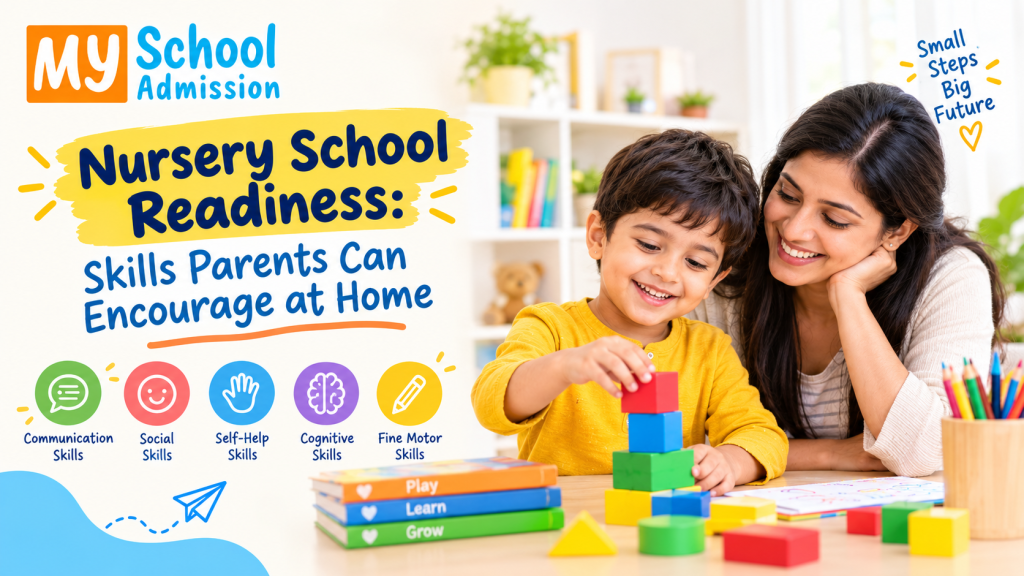
Nursery school readiness is not about teaching a child everything they may encounter in a classroom. It is about building the confidence, communication, independence, and everyday skills they need to feel comfortable in a new environment.
Starting nursery is a major transition. Children may need to spend time away from parents, follow routines, communicate with teachers, interact with peers, and manage simple tasks independently. While they do not need to master everything beforehand, practising these skills at home can make the transition smoother.
What Does Nursery School Readiness Mean?
Nursery readiness includes several developmental and practical skills:
- Communication and listening
- Basic self-care
- Social interaction
- Emotional regulation
- Following simple instructions
- Motor skills
- Early thinking and learning
- Growing independence
Readiness is not a test. Every child develops at a different pace and may be confident in some areas while needing support in others. The goal is to provide opportunities for practice without creating pressure.
A Simple Readiness Checklist
Before nursery begins, parents can encourage children to gradually learn to:
- Follow one- or two-step instructions
- Communicate basic needs
- Eat and drink independently
- Ask for help
- Wash and dry their hands
- Put toys and belongings away
- Wait briefly for their turn
- Participate in simple group activities
- Separate from parents for short periods
- Listen to a short story
- Use crayons and other age-appropriate tools
- Follow a familiar routine
These are guidelines, not admission requirements. Schools may have different expectations, and children may develop these abilities at different times.
Encourage Independence Through Everyday Activities
Simple daily routines can help children become more confident and capable.
Give your child a designated place for shoes, bags, toys, and books and encourage them to put things away. Let them practise opening their lunch box and water bottle. Make handwashing part of everyday routines so it becomes familiar rather than something they have to remember only at school.
Most importantly, teach children to ask for help. Practise phrases such as, “Can you help me?”, “I don’t understand,” or “I can’t open this.” Knowing how to communicate a need can make children feel more secure in a new environment.
Learning Through Play
The best preschool preparation does not have to feel like schoolwork. Play provides opportunities to develop several skills naturally.
Sorting games: Group toys by colour, size, shape, or type to develop observation, classification, and early thinking skills.
Storytime: Talk about characters, pictures, and events to build vocabulary, listening, and comprehension. Encourage your child to describe what they see or remember.
Pretend classroom: Play teacher and student to practise listening, following instructions, packing a bag, participating in an activity, and saying goodbye.
Drawing and colouring: These activities support hand and finger coordination while allowing children to express themselves creatively.
Movement games: Jumping, dancing, balancing, throwing, and simple obstacle courses build coordination while encouraging children to listen and follow instructions.
Build Communication and Problem-Solving Skills
Talk to your child throughout the day. Describe what you are doing while cooking, shopping, travelling, or getting ready. Everyday conversations naturally introduce new vocabulary and help children become comfortable expressing themselves.
Encourage curiosity rather than expecting immediate answers. When a child encounters a problem, ask, “What could we try?” or “How can we make it stronger?” This encourages independent thinking and gives children confidence in trying different solutions.
Social and Emotional Readiness
Nursery may be a child’s first regular experience in a group of peers. Through play and family activities, practise taking turns, sharing, waiting, listening, joining games, and expressing disagreement appropriately.
Children do not have to be naturally outgoing to be socially ready. Some may take longer to approach new people or join group activities. Giving them opportunities to interact at their own pace can help.
Emotional readiness is equally important. Help children name feelings such as excitement, frustration, disappointment, or sadness. Simple calming strategies, such as taking slow breaths or asking an adult for help, can also be introduced.
Practise Separation and Routines
For some children, saying goodbye can be harder than the classroom itself. Before nursery begins, practise short, predictable separations with a trusted adult. Tell your child where you are going and when you will return. Avoid disappearing without saying goodbye, as predictable departures can help children feel more secure.
A predictable home routine can also help. Establish regular timings for waking up, breakfast, getting dressed, play, meals, and bedtime. The goal is not to copy the school’s timetable but to help children become comfortable moving between activities
What Parents Should Avoid
Avoid turning preparation into constant testing or comparing your child with others. A child who takes longer to master a particular skill is not necessarily less prepared for nursery.
Learning can happen naturally through books, songs, games, conversations, and everyday activities. Keep preparation positive and age-appropriate.
Also avoid presenting school as something frightening. Instead, explain that teachers are there to help, guide, and support children. Positive conversations about school can help children approach the experience with greater confidence.
Final Thoughts
Preparing a child for nursery is less about academic milestones and more about building confidence for everyday experiences. Getting dressed, putting toys away, listening to stories, playing with others, asking questions, and expressing feelings can all become valuable preparation.
The goal is not to send a child to nursery who can already do everything. It is to help them feel capable of trying, asking for help, learning from others, and gradually becoming more independent.
With patience, play, predictable routines, and encouragement, home can become the first place where children develop the confidence they need for their next big step.
FAQs
1. Does my child need to read and write before nursery?
Not necessarily. Communication, self-care, social interaction, listening, and following instructions are also important. Check the specific expectations of your chosen school.
2. What if my child behaves differently outside home?
This can be common. Give your child time to become comfortable in new environments rather than assuming they have forgotten their skills.
3. How can I prepare my child for separation?
Practise short, predictable separations with trusted adults and explain when you will return. If difficulties continue, discuss the transition with the nursery.
4. How long should we practise readiness activities?
There is no fixed amount of time. Short activities incorporated into everyday play and routines can be enough. Even simple moments such as reading a story, sorting toys, or practising a lunch box can support nursery readiness.