
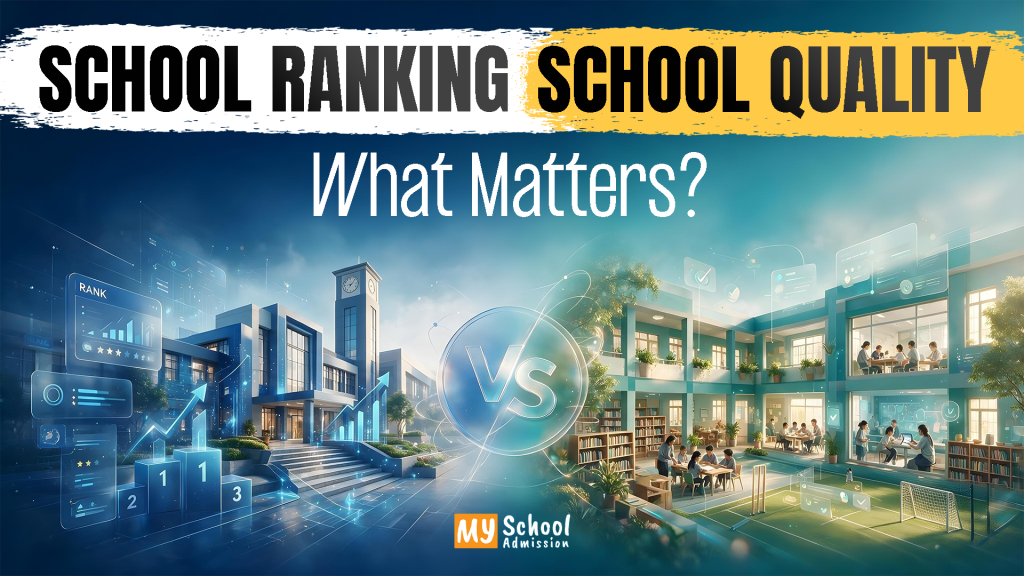
Every year, when admission season rolls around, parents find themselves comparing lists, “Top 10 Schools in Bangalore,” “Best CBSE Schools in Bangalore,” and so on. These lists feel reassuring because they turn a confusing decision into something that looks simple: pick the highest-ranked school and you’re done.
But school ranking and school quality are not always the same thing. A school can rank high on a magazine survey and still not be the right fit for your child. Another school with no ranking at all might have exactly the environment your child needs to thrive. Understanding the difference between the two can save parents from making a decision based on prestige alone.
What Does School Ranking Actually Measure?
School ranking is usually based on surveys, often conducted by education magazines, newspapers, or research agencies. Parents, teachers, or school principals are asked to rate schools on factors like academic reputation, infrastructure, teaching faculty, and co-curricular activities. The responses are compiled into a score, and schools are ranked accordingly.
This sounds objective, but it has real limitations:
- Rankings are often based on perception and reputation, not verified data from every school
- A school’s marketing budget and media visibility can influence how “well-known” it is, which affects survey responses
- Rankings rarely account for how a specific child will experience that school, a highly ranked school known for academic rigour may not suit a child who needs a slower, more supportive pace
- Most ranking surveys cover only a limited number of schools in each city, leaving out many good schools that simply weren’t part of the survey
In short, a school ranking tells you how a school is perceived by a sample of people. It doesn’t necessarily tell you how that school will work for your child.
What Does School Quality Actually Involve?
School quality is a broader, more practical measure. It looks at what actually happens inside the school, day to day, and how well it supports a child’s growth. Some of the factors that genuinely reflect school quality include:
- Teaching approach — whether teachers focus on rote learning or help children understand concepts
- Student-teacher ratio — smaller class sizes usually mean more individual attention
- Infrastructure and safety — classrooms, labs, playgrounds, transport, and safety measures on campus
- Curriculum fit — whether the board and teaching style suit your child’s learning pace and interests
- Extracurricular exposure — sports, arts, music, and clubs that support all-round development, not just academics
- School culture — how the school handles discipline, inclusivity, and a child’s emotional well-being
- Parent and student feedback — real experiences from families already at the school, which often reveal more than any survey
School quality is harder to summarise in a single number, which is exactly why it’s more useful. It reflects the actual day-to-day experience your child will have, rather than a reputation built on surveys.
CBSE School Ranking: Why It Needs a Closer Look
Since CBSE is the most widely followed board in India, CBSE school ranking lists are extremely common, especially around admission time. Parents often assume that a top-ranked CBSE school guarantees the best outcomes. But CBSE school ranking, like any other ranking, is based on general parameters, average academic results, faculty strength, and infrastructure, applied broadly across schools.
What a CBSE school ranking usually won’t tell you:
- How a specific branch or campus of a school chain performs, since rankings are sometimes given at the group level, not the individual school level
- How the school supports children who need extra academic help, or those who excel beyond the standard curriculum
- The real classroom experience, teacher turnover, or how updated the teaching methods actually are
- Whether the school’s fee structure matches the value it delivers
This doesn’t mean CBSE school ranking is useless. It can be a helpful starting point to shortlist a few schools worth researching further. The mistake is treating it as the final word instead of the first step.
How Should Parents Actually Use Rankings?
Think of school ranking as a filter, not a verdict. It can help you narrow down a long list of schools into a shorter one worth exploring. From there, school quality should guide the final decision. A practical approach looks like this:
- Use rankings to identify a handful of well-regarded schools in your preferred locality and board
- Visit school profiles or websites to check curriculum, fees, and facilities in detail
- Read parent reviews to understand real experiences, not just marketing claims
- Compare shortlisted schools side by side on the factors that matter most to your family, location, fees, curriculum, and facilities
- Wherever possible, visit the campus or speak to the admissions team before finalising
This way, ranking helps you start the search, and school quality helps you finish it.
Making the Search Easier
Researching every school individually, checking fees, facilities, curriculum, and reviews one by one, can take weeks. Platforms like My School Admission bring this information together in one place. Parents can search schools by city, locality, board, and budget, use the Compare School tool to view shortlisted schools side by side, and read verified parent reviews before making a decision. Free expert counselling is also available for parents who want guidance beyond what a ranking list can offer.
The Bottom Line
School ranking and school quality answer two different questions. Ranking shows how a school is perceived or compared with others, while quality tells you how well the school may actually meet your child’s needs. Rankings can help you create an initial shortlist, but looking closely at the school’s quality, facilities, teaching, and overall environment should guide your final decision.
Frequently Asked Questions
Is a highly ranked school always the best choice?
Not necessarily. A high ranking reflects general perception, not how well the school suits your child’s specific needs, pace, and personality.
What is the difference between school ranking and school quality?
School ranking is based on surveys and perception. School quality looks at real factors like teaching, facilities, and student well-being.
Are CBSE school ranking lists reliable?
They’re a useful starting point but shouldn’t be the only factor. Always verify details at the specific school or branch you’re considering.
How can parents check school quality beyond rankings?
Read parent reviews, check facilities and curriculum on the school profile, and visit the campus if possible before deciding.
Do unranked schools mean lower quality?
No. Many good schools aren’t part of ranking surveys simply because they weren’t included, not because they lack quality.
Should fees be considered along with rankings?
Yes. A top-ranked school isn’t automatically worth its fee. Compare fees against facilities, curriculum, and outcomes offered.
How does MSA help parents beyond ranking lists?
MSA lets parents compare schools on fees, facilities, and curriculum, and read real parent reviews, alongside free admission counselling.
What should parents prioritise when shortlisting schools?
Prioritise curriculum fit, location, facilities, and your child’s learning style over ranking alone for a decision that truly suits your family.